
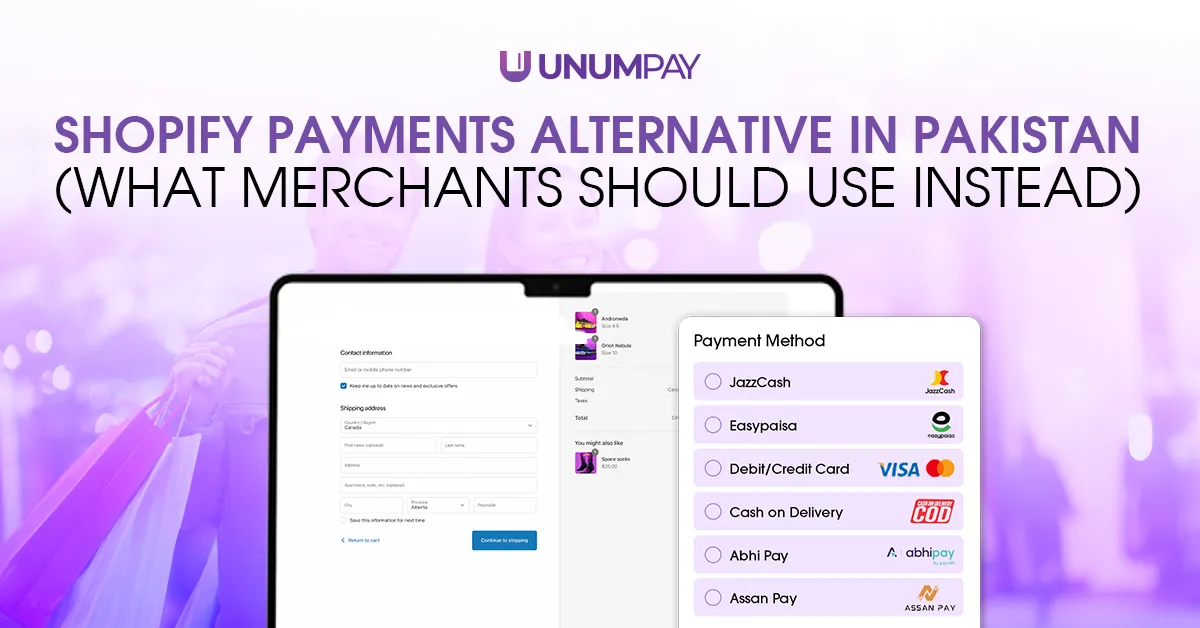
Shopify is fully available in Pakistan and works well for building and running an online store. However, Shopify Payments — Shopify’s built-in payment processor — is not supported in Pakistan. Pakistani merchants need to connect a third-party payment provider to accept payments at checkout. This post explains why, what the alternatives are, and how to set up a payment solution that actually works for the Pakistani market.
Table of Contents
- 1.Can Merchants Use Shopify in Pakistan?
- 2.Is Shopify Payments Available in Pakistan?
- 3.Why Pakistani Merchants Need an Alternative Setup
- 4.What Payment Methods Matter Most in Pakistan
- 5.What Merchants Should Use Instead of Shopify Payments
- 6.How UnumPay Supports a More Flexible Setup
- 7.Frequently Asked Questions
- 8.The Bottom Line
Can Merchants Use Shopify in Pakistan?
Yes. Shopify works in Pakistan. Merchants can sign up, build a store, list products, manage orders, and run their business on Shopify without any restrictions. The platform itself is fully accessible to Pakistani merchants, and thousands of stores across Pakistan are already running on Shopify today — including established brands like Nishat Linen, Sapphire, and Habitt.
The limitation is not Shopify itself. It is Shopify Payments.
Is Shopify Payments Available in Pakistan?
No. Shopify Payments is not available in Pakistan. This is the most common point of confusion for merchants getting started with Shopify in Pakistan, and it is worth being direct about what it means in practice.
Shopify Payments is Shopify’s built-in payment processing solution. It is available in around 20 countries, mostly in North America, Europe, and select Asia-Pacific markets. Pakistan is listed as an unsupported Shopify Payments country, along with most of the MENA region, South Asia, and parts of Africa.
When Shopify Payments is unavailable, merchants cannot use it to process card payments at checkout. There is no workaround within Shopify Payments itself. The solution is to connect a third-party payment provider — which Shopify fully supports through its payment settings.
Why Pakistani Merchants Need an Alternative Setup
The absence of Shopify Payments does not just mean finding a substitute processor. It means building a payment setup that is genuinely suited to how Pakistani customers prefer to pay — which looks quite different from the markets Shopify Payments was built for.
Here is what Pakistani merchants run into without the right alternative in place:
- Lost sales at checkout. When customers do not see a familiar or preferred payment option, they abandon the cart. In Pakistan, that means missing buyers who rely on JazzCash, Easypaisa, or bank transfers.
- Fragmented payment management. Most merchants who try to solve this by signing up with multiple gateways individually end up managing separate dashboards, separate settlement timelines, and separate reconciliation processes.
- No payment redundancy. Relying on a single gateway is a business risk. If that provider experiences downtime during a peak sales period, the store loses revenue with no fallback.
- Limited ability to scale cross-border. Pakistani merchants increasingly sell to customers in the UAE, the UK, and other international markets. A payment setup built only for local buyers creates a ceiling on that growth.
What Payment Methods Matter Most in Pakistan
Before choosing a Shopify payments alternative in Pakistan, it helps to understand what Pakistani customers actually use. The payment landscape here is distinct from Western markets, and a setup that ignores local preferences will underperform regardless of how well-integrated it is technically.
- Mobile wallets — JazzCash and Easypaisa. These are the most widely used digital payment methods in Pakistan. A growing share of online buyers, particularly outside major cities, pay exclusively through mobile wallets. Offering at least one of these at checkout is no longer optional for most stores.
- Debit and credit cards. Visa and Mastercard remain the primary choice for urban buyers and higher-value purchases. Any payment setup needs reliable card acceptance as a baseline.
- Bank transfers. Direct bank-based payments are common among buyers who prefer not to use cards or wallets, especially for larger orders.
- Cash on Delivery (COD). COD remains significant across Pakistan, particularly for first-time buyers and customers in smaller cities who are less comfortable with digital payments.
- Fintech and digital payment platforms. Providers like Keenu, Abhi Pay, and Assan Pay are expanding digital payment access in Pakistan and are increasingly relevant for merchants targeting younger, urban demographics.
No single gateway covers all of these. This is the core reason why a multi-gateway approach — managed from one place — is the most practical setup for Pakistani Shopify merchants.
What Merchants Should Use Instead of Shopify Payments
Pakistani merchants have two broad options when setting up an alternative to Shopify Payments.
Option 1 — Connect individual third-party gateways directly. Shopify allows merchants to connect standalone third-party payment providers through its payment settings. You can sign up with HBL, MCB, JazzCash, or any Shopify-compatible gateway and add it to your store individually. This works, but managing multiple providers this way means separate setups, separate dashboards, and separate reconciliation for each one.
Option 2 — Use a payment mediation platform. A payment mediation platform sits between your Shopify store and multiple gateways, connecting them all through a single integration. You manage everything — activation, reporting, reconciliation — from one dashboard, while your customers see all relevant payment options at checkout.
For most Pakistani merchants, Option 2 is the more practical and scalable choice. Here is a direct comparison:
| Shopify Payments | Third-party setup via UnumPay | |
|---|---|---|
| Available in Pakistan | No | Yes |
| Local wallets (JazzCash, Easypaisa) | No | Yes |
| Pakistani bank gateways | No | Yes |
| International gateways | Limited | Yes (40+ PSPs) |
| Multi-gateway management | Not applicable | Single dashboard |
| Setup complexity | Built-in (not available) | No-code, minutes to go live |
| Transaction fee | Not applicable | 0.85% per transaction |
| Monthly subscription | Not applicable | Free to install |
How UnumPay Supports a More Flexible Setup
UnumPay is a Shopify-approved payment gateway mediation platform that connects Pakistani Shopify merchants to 40+ payment service providers through a single integration. It is not a payment gateway itself — it is the layer that makes multiple gateways manageable from one place.
For merchants setting up online payments on Shopify in Pakistan, UnumPay covers the full range of local payment methods:
- Mobile wallets: JazzCash, Easypaisa
- Pakistani bank gateways: HBL, MCB, Bank Alfalah, Meezan Bank, BOP, Allied Bank
- Fintech providers: Keenu, Abhi Pay, Assan Pay
- International gateways: Checkout.com, Authorize.net, and more — for cross-border selling
How the merchant payment setup works:
- Install UnumPay from the Shopify App Store — free, no monthly fee
- Open a merchant account with whichever payment providers you need
- Add your gateway credentials inside UnumPay
- All selected gateways go live on your Shopify checkout — no coding required
From that point, everything is managed through one unified dashboard: transactions, success rates, revenue reporting, and reconciliation across every connected provider. No switching between portals. No manually piecing together settlement data from separate sources.
UnumPay is trusted by 2,500+ merchants across 45+ countries and processes 80,000+ transactions per month, with a 4.6-star rating on the Shopify App Store. Its pricing is usage-based — 0.85% per transaction, no setup fees, no monthly charges.
For Pakistani merchants, this means the platform grows with the store. Start with two or three local gateways, then add international options as cross-border sales develop — all without rebuilding the payment infrastructure.
- Explore payment coverage for Pakistan
- See UnumPay pricing details
- Find relevant FAQ
- Install on Shopify now
Frequently Asked Questions
Is Shopify available in Pakistan? Yes. Shopify is fully available in Pakistan. Merchants can sign up, build a store, and manage their business without restriction. Shopify Payments, however, is not available — a third-party payment provider is needed to accept payments.
Does Shopify work in Pakistan without Shopify Payments? Yes. Shopify works perfectly well in Pakistan using third-party payment providers. Most Pakistani Shopify merchants use a combination of local gateways and a mediation platform like UnumPay to manage payments.
What is the best Shopify payments alternative in Pakistan? A payment mediation platform like UnumPay is the most practical alternative. It connects your store to local providers like JazzCash, Easypaisa, and Pakistani bank gateways, plus international options — all through one integration.
Can I accept JazzCash and Easypaisa on Shopify in Pakistan? Yes. Both JazzCash and Easypaisa are supported through UnumPay. Open a merchant account with each provider, add your credentials in UnumPay, and both appear as checkout options for your customers.
How do I set up a payment gateway on Shopify in Pakistan? Go to Shopify admin > Settings > Payments > Third-party providers. Select your provider or install UnumPay to connect multiple gateways through one integration.
Is there a transaction fee for using a third-party payment gateway on Shopify in Pakistan? Shopify charges an additional transaction fee (0.5%–2% depending on your plan) when using third-party providers instead of Shopify Payments. UnumPay itself charges 0.85% per transaction on top of your PSP’s direct fees.
Can Pakistani Shopify merchants accept international payments? Yes. Through UnumPay, Pakistani merchants can connect international gateways like Checkout.com and Authorize.net alongside local providers — enabling both domestic and cross-border payment acceptance from one platform.
What is an unsupported Shopify Payments country? An unsupported Shopify Payments country is one where Shopify’s built-in payment processor is not available. Pakistan falls into this category, along with most of the MENA region and parts of South Asia. Merchants in these countries must use third-party providers to accept payments on Shopify.
Do I need a merchant account to accept payments on Shopify in Pakistan? Yes. To connect a payment gateway to your Shopify store, you need a merchant account with that provider. UnumPay simplifies this by letting you manage credentials for multiple merchant accounts from one dashboard.
Is UnumPay free to use in Pakistan? UnumPay is free to install with no monthly subscription. It charges 0.85% per transaction, on top of whatever fees your chosen payment providers charge directly.
The Bottom Line
Shopify works in Pakistan. Shopify Payments does not. But that is not a roadblock — it is simply a prompt to build a more thoughtful payment setup than the default.
Pakistani merchants who take the time to connect the right local payment methods — JazzCash, Easypaisa, bank gateways, and COD — alongside international options for cross-border selling will outperform stores that settle for a single gateway. A platform like UnumPay makes that setup fast, manageable, and scalable without requiring developers or multiple separate integrations.